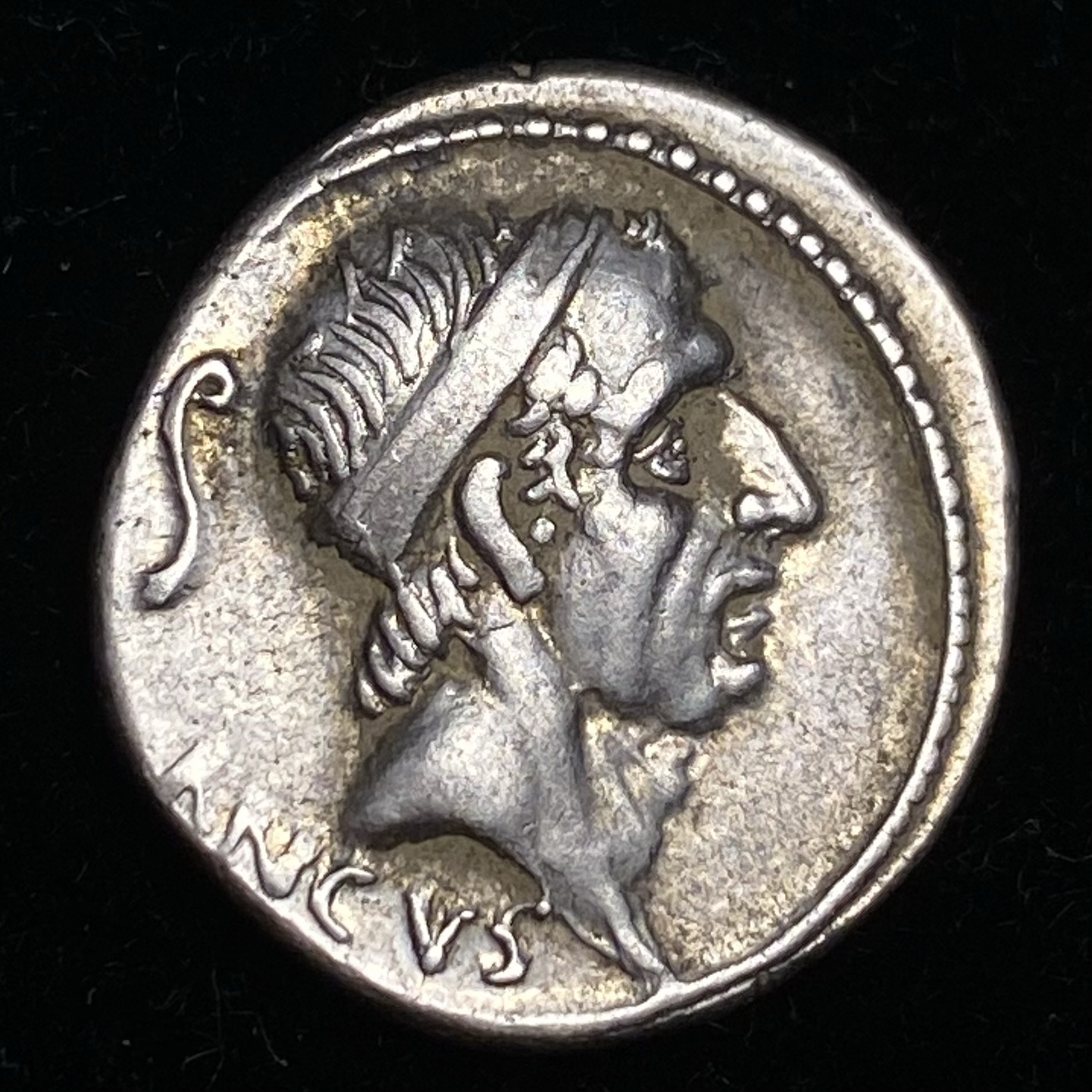
Who Is on the Statue? The Aqua Marcia Denarius

Obverse: Diademed head of Ancus Marcius, right; behind lituus and below ANCVS

Reverse: Equestrian statue of Q. Marcius Tremelus, standing on top of an aqueduct; at horse's feet, flower. Below, AQVA MAR within the arches of the aqueduct; Border of dots.
Denarius of L. Marcius Philippus · 56 BCE · Crawford 425/1; RBW 1524; BMCRR Rome 3890

The Aqua Marcia aqueduct
Source: Wikimedia Commons
The first to begin the bringing of this water to Rome was one of the kings, Ancus Marcius ; later, repairs were carried out by Quintus Marcius Rex in his praetorship, and again by Marcus Agrippa.
But we must go on to describe marvels which are unsurpassed in virtue of their genuine value. Quintus Marcius Rex, having been ordered by the senate to repair the conduits of the day Aqua Appia, the Anio, and the Tepula, drove underground passages through the mountains and brought to Rome a new water-supply called by his own name and completed within the period of his praetorship.
Ancient Kings and Aquaducts
Ancient coins can provide clear messages for their meaning and at other times the story they wish to tell is rather opaque. Take the obverse of this coin. A noble diademed bust with ANCVS written behind is a clear indication the obverse represents the mythical fourth king of Rome, Ancus Marcius. The reverse dramatically shows an aqueduct with the letters AQVA MAR below clearly spelling out to the viewer this is the Aqua Marcia built by the praetor Q. Marcius Rex between 144-140 BCE1. The moneyer, L. Marcius Philippus, is using this miniature monument to celebrate the Marcii gens through the connection to Rome’s king and the aqueduct2. The connection is meaningful as Ancus was reported to be the first to bring water to the city via aqueduct3. However, the identity and purpose of the equestrian statue is a bit muddled- who is that statue and why is it on top of an aqueduct?
Use of Imagery and Identification
First, let’s disabuse ourselves of the requirement that the reverse depicts a true to life scene. Roman moneyers often invoked mythical imagery, ancient heroes, pulled from various distant family branches, or depicted buildings not yet finished to convey meaning4. Furthermore, a statue on top of an aqueduct is both an engineering impossibility and a political waste5. The aqueduct was buried on its route to the Capitoline and so any standing equestrian statue would be far from the city and the viewing populace with little political value. Consequently, Grueber’s claim that “In commemoration of the great benefit derived from this new water supply the Senate placed an equestrian statue of Marcius on the aqueduct” 6 is unsupported in fact and in practice.
So if there wasn’t an enormous statue on an aqueduct, who/what was intended for the audience to recall? We have seen Grueber’s claim to be it being of Q. Marcius Rex, but Crawford is more circumspect stating clearly “The statue is problematical” 7 and simply summarizing it as “equestrian”. This missing piece of this puzzle is not textual, but archaeological. Both Crawford and Mommsen8 point to a military diploma from a discharge legionary found far from the Captioline Hill to help reveal the statue’s identity. Stunningly, that find was preserved and is available electronically to read:
ROMAE • IN • CAPITOLIO • POST • AEDEM • IOVIS • O . M . IN BASI • Q • MARCI • REGIS PR
Which translates as: “At Rome, on the Capitoline behind the temple of Jupiter Optimus Maximums on the pedestal [of the statue] of Q. Marcius Rex praetor” 9.

Military diploma upper portion

Military diploma lower portion
Military diploma of Gaius Pontius, CIL XVI, 5. Source: Wikimedia Commons
Upon their discharge, legionaries were often granted citizen and a land allotment. This grant of citizenship was publically recorded, so that in theory, their rights could be verified. This diploma from the late Republic was found in Illyria and was likely the soldier’s personal copy, with the “official” copy attached to the statue of Q. Marcius Rex, that existed on the Capitoline Hill.
Conclusion or New Directions?
So that’s it? The status is Q. Marcius Rex through hard archaeological evidence now. Well, new scholarship by Dr. Liv Yarrow in “The Roman Republic to 49BCE: Using Coins as Sources” has begun to turn this understanding on its head. Yarrow, building on the work by Hölkeskamp, argues that the statue is of Q. Marcius Tremulus (cos. 306), who was a hero of the early Republic for twice defeating the Samnites and then the Anagni. The key to identifying Tremulus is the depiction of the rider as wearing a toga, rather than military garb. In a brief description of the statue, Pliny specifically calls out this distinction:
Also there was in front of the temple of the Castors an equestrian statue of Quintus Marcius Tremulus, wearing a toga ; he had twice vanquished the Samnites, and by taking Anagni -Pliny, Natural History 34:23
The Temple of Castor and Pollux is at the heart of the Forum and the statue of Tremulus would be visible and recognizable to any Roman citizen. Yarrow argues that the use of Tremulus’ statue, paired with the Aqua Marcia, is an attempt to re-appropriate the massive project for the Marcii Philippi (the gens to which our moneyer belongs) and away from the Marcii Reges (the gens of its builder, Q. Marcius Rex). Tremelus is also a repeated figure on coins of the Marcii Philippi, all as a rider on horseback. Furthermore, the design itself may have been in contest with similar claims of the Aemili Lepidii over the “ownership” of the aquaduct who earlier issued coins showing an equestrian rider over top an unnamed aquaduct10. I find myself wanting to agree with Yarrow but wishing to dive into these other Marcii coins to truly see the connection to Tremulus11.
Reverse of our denarius of L. Marcius Philippus

Competing claims to the aqua Marcia by Mn. Aemilius Lepidus (CRR 293/1) Source: ANS 1941.131.97

Denarius of Q. Marcius Philippus (Crawford 259/1) issued in 129 BCE showing Tremelus on horseback. Source ANS 1963.31.39

Denarius of L. Marcius Philippus (Crawford 293/1) issued in 113/112 BCE. Source ANS 1992.41.10
The Joys of the Late Republic
This long tortured story about the simple question of “who is on the statue?” is why I love late Republican coinage. These small objects are steeped in myth, memory, and politics. For a hobby, it provides the ability to examine beautiful objects, dive into historical books, and weigh arguments of academic titans. It’s quite a fun and lengthy journey.
References and Footnotes
-
“The Senate commissioned Marcius, who at that time administered the law as praetor between citizens, to reclaim and repair these conduits; and since the growth of the City was seen to demand a more bountiful supply of water, the same man was charged by the Senate to bring into the City other waters so far as he cloud”. -Frontius De Aquaducts I, 7 ↩
-
“Several decades later, in 56 BCE, on the obverse of the coinage of a certain Philippus, one finds Ancus Marcius again, alone this time, wearing a crown and with a lituus behind him. In this way, the moneyer, who can probably be identified as L. Marcius Philippus, son of the consul of the same name in that year and himself consul suffectus in 38 bce, alludes to the augurate of his like-named grandfather, who was consul in 91 BCE and censor in 86 BCE” -Karl-J Hölkeskamp, ‘In the Web of (Hi-)Stories: Memoria, Monuments, and Their Myth-Historical ‘Interconnectedness’’, in Karl Galinsky (ed.), Memory in Ancient Rome and Early Christianity ↩
-
“The first to begin the bringing of this water to Rome was one of the kings, Ancus Marcius; later, repairs were carried out by Quintus Marcius Rex in his praetorship, and again by Marcus Agrippa.” -Pliny, Natural History, Book 31, Chapter 24 ↩
-
“In the more widely-spread medium of coinage, even greater liberties were taken, and the multilayered ambiguous images and complex combinations of motifs and symbols in the coinage of the late Republic document this trend. It was common practice for the tresviri monetales in charge of issuing coinage, mostly young men at the beginning of their careers, not only to adopt familial, symbolic capital in a strict sense, but also to include well-known achievements of their ancestors from other branches of their gens in their own account and even to suggest bold, even fantastical genealogical combinations, which did not have any place in the Republican family tree (e.g. not in the official imagines of the ancestors in the atrium and mutatis mutandis in the pompa funebris), such as the descent of the gens from mythical characters, gods, demigods, and heroes” -Karl-J Hölkeskamp, ‘In the Web of (Hi-)Stories: Memoria, Monuments, and Their Myth-Historical ‘Interconnectedness’’, in Karl Galinsky (ed.), Memory in Ancient Rome and Early Christianity ↩
-
“Moreover, no one would wish to assert that the statue was actually superimposed upon the arches of the aqueduct—that would be utterly ridiculous; nor could the arches have been situated on the Capitol, where subterranean tunneling—rather than arched construction—was required.” - Translation from Orelli-Henzen, n° 5088, 6838. - Bullet, de l’lust, arch., 1845, р. 121 ↩
-
BMCRR Rome p. 486; To support this statement Gruber cites Mommsen’s description of the coin in Histoire de la monnaie romaine Volume II p. 513. However, Mommsen simply calls the statue equestrian, but in a footnote, indicates that is probably Q. Marcius Rex citing an inscription from a military diploma which will be crucial later in our discussion. ↩
-
Crawford references (CIL xvi, 5), while Mommesen deep in Histoire de la monnaie romaine Volume II p. 513 (footnote 4) points to Orelli-Henzen, n° 5088, 6838. - Bullet, de l’lust, arch., 1845, р. 121 ↩
-
I am thankful for Dr. Eva Carrara for this translation and finding the sources for this diploma. ↩